Running a red light: What are the penalties and risks?
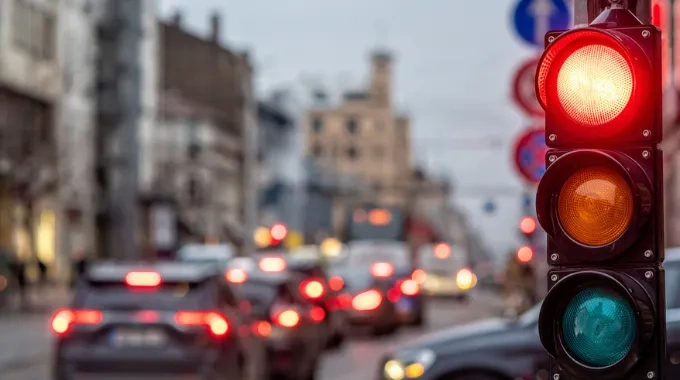
Running a red light is a dangerous traffic offence. Traffic lights help maintain order on the roads, and ignoring them can put the lives and health of both the driver and other road users at risk.
In Latvia, this offence carries an administrative fine ranging from €30 to €140. Let’s look at the penalties for running a red light when the offence is recorded by a red-light camera.
What are the penalties for running a red light?
In Latvia, failing to obey a prohibitory traffic signal carries an administrative penalty under Section 52, Paragraph 1 of the Road Traffic Law:
Driving against a prohibitory traffic signal, failing to obey a traffic controller’s signal, or driving in a direction prohibited by a traffic controller’s signal carries a fine of three fine units for cyclists and between six and twenty-eight fine units for drivers of other vehicles.
This means that a fine for running a red light, including an offence recorded by a camera, ranges from €30 to €140 for drivers of motor vehicles.
How can you avoid an offence and a fine?
To avoid fines and other penalties under road traffic legislation, drivers should always pay attention to traffic lights. Watch the signals well in advance and be ready to stop when necessary.
It is also important to maintain a safe speed. Do not treat an amber light as an invitation to accelerate, but as a warning to slow down and prepare to stop. Always follow road signs and traffic controllers’ instructions.
Keeping a safe distance from the vehicle ahead helps you avoid sudden braking and unexpected manoeuvres. Remember that junctions are often monitored by cameras that can record offences. Traffic violations may result in both fines and penalty points.
Red-light cameras and their role
Red-light cameras are part of a traffic monitoring system that automatically records vehicles passing through a red light. Installed near traffic lights, these cameras use algorithms to identify and record offences.
When a vehicle crosses a junction against a red light, the system follows several steps:
- Detection: The camera identifies the traffic signal and the vehicle’s movement.
- Number plate recognition: High-resolution cameras read the vehicle’s registration number.
- Trajectory analysis: The system analyses the vehicle’s movement to determine whether an offence has occurred.
- Data transmission: The information is sent to the Road Traffic Safety Directorate (CSDD) and the municipal police for a decision on the penalty.
Red-light cameras offer several benefits, primarily improving road safety and reducing the number of accidents at junctions. They provide continuous, efficient traffic monitoring and automatically record offences. Their presence also acts as a deterrent, encouraging drivers to be more careful and less likely to break the rules because of the risk of a fine.
Despite these advantages, the system also has limitations. One of the main challenges is technical faults, which can lead to offences being recorded incorrectly. There is also a risk that the system may not always distinguish genuine offences from exceptional circumstances.
How does running a red light endanger road safety?
Ignoring a red light is a dangerous traffic offence that can cause road accidents. When a driver crosses a junction against a red light, whether deliberately or through inattention, there is a significant risk of colliding with vehicles legally crossing on a green light. Such collisions often happen at high speeds and can cause serious injuries or even fatalities.
Beyond collisions between vehicles, running a red light also endangers pedestrians and cyclists. It directly threatens vulnerable road users and can leave pedestrians unable to cross safely, even when their signal is green.
Why stopping at red lights matters
Running a red light significantly increases the risk of a collision. Pedestrians and cyclists are particularly vulnerable, as they rely on drivers to obey traffic signals.
Red-light cameras are used to help reduce these offences and improve road safety by automatically recording violations. Drivers who run a red light can face a fine of up to €140.
